

Is It Better to Spray or Brush Kitchen Cabinets?
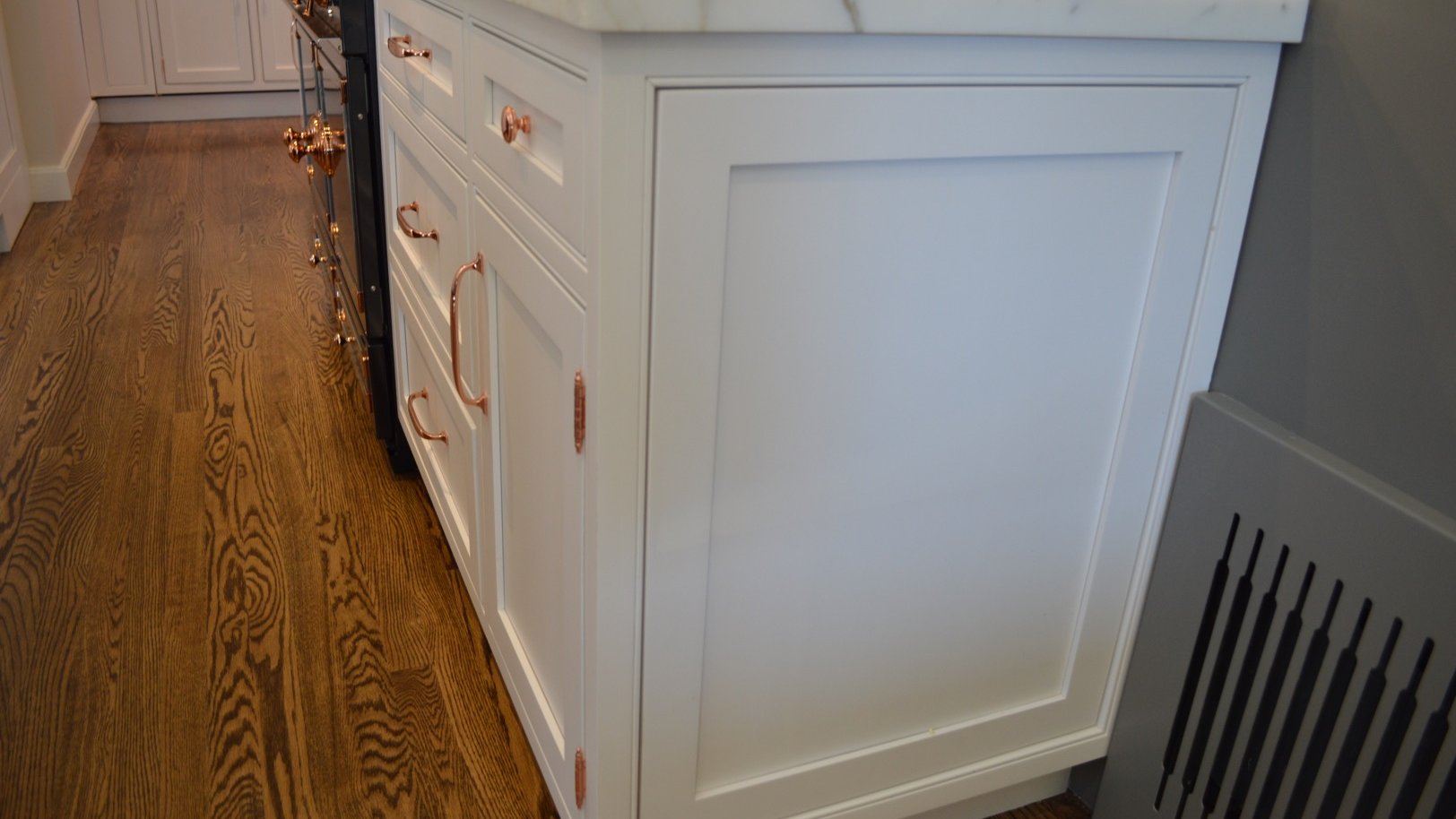
Spraying is better for kitchen cabinets for two reasons: no brush marks, and an even film that keeps the sheen matched door to door. Brushing and rolling still suit touch-ups and small jobs painted in place, but the factory-smooth look designers ask for comes from a sprayer.
Most people think of spraying as the fast way to paint. On kitchen cabinets it’s the slow way. Every door comes off and gets labeled, and the kitchen gets sealed in plastic before a drop of finish goes on. It’s still the method we’d choose.
Darien’s housing spans the better part of a century. Its median home was built in 1957, per the U.S. Census Bureau’s American Community Survey for 2019 to 2023. But 28% of the stock predates 1940, 20% went up in 2000 or later, and 83% of homes are owner-occupied.
In Darien, in Noroton and along the Post Road, a meaningful share of our work comes through interior designers and architects. They specify the sheen as carefully as the stone, so the method matters.
Why does a sprayed cabinet look smoother than a brushed one?
A sprayed cabinet looks smoother because the sprayer breaks the finish into a fine mist. It lands as an even film and levels out before it sets. A brush leaves faint ridges in the direction of the stroke. A roller leaves a fine stipple, a texture painters call orange peel.
Those differences are small on a white satin door seen straight on. In raking light, on a dark or glossy color, they’re the first thing you notice.
In a luxury kitchen, a brush mark on a high-gloss door reads as a defect. Whoever specified that door will see it first.
How do spraying, brushing and rolling compare on cabinets?
Each method leaves a different surface, and each fits a different part of the kitchen:
| Method | Finish | Where it fits | Trade-offs |
|---|---|---|---|
| Spraying doors and drawer fronts in a shop | The smoothest, most even finish, with no brush marks and a consistent sheen | Doors, drawer fronts and loose panels | The doors are off for the job, and every piece has to be labeled and rehung |
| Spraying boxes in a sealed kitchen | Matches the doors on face frames, end panels and islands | Cabinet boxes and anything fixed to the wall | The whole kitchen has to be masked and contained, with exhaust to the outside |
| Brushing | A fine brush texture that shows in raking light, more on dark or glossy colors | Touch-ups, small pieces and detailed moldings | Slower on flat panels, and harder to keep the sheen even |
| Rolling with a fine foam or microfiber roller | A light orange-peel texture | Flat slab doors and box sides on small jobs | Texture shows on glossy finishes, and edges and profiles still need a brush |
For a look at how we’d set up your kitchen, call 1 (800) 687-9470 and book a free in-home consultation.
How do we spray a kitchen while you’re still living there?
We spray a kitchen in two places: the doors and drawer fronts in our shop, and the boxes in the kitchen itself. Every door and drawer comes off and goes to our shop for prep and finish. In the house, we seal the kitchen in plastic and turn it into a spray booth, with an exhaust system venting to the outside.
Everything we spray is VOC compliant and low in odor, so there’s no need to leave home. When the spraying’s done, the plastic comes down and every door and drawer goes back in its original position.
At Palette Pro Painting & Renovation, that’s the standard setup for our cabinet refinishing work. New cabinetry gets the same treatment, so unfinished custom cabinets your designer ordered can match the rest of the kitchen.
Our favorite moment is when the plastic comes down and the light hits the doors. That finish is so even you’ll want to run a hand across it. You’ll find more kitchens in our kitchens portfolio.
When is a brush the better choice?
A brush is the better choice for touch-ups and for small pieces where sealing off a whole room isn’t worth it. Some homeowners also want a hand-painted look on a furniture-style island or hutch, and there the brush is the point.
Sprayed finishes have a limit, too. They show any flaw in the prep underneath, so a sprayer can’t make up for skipped sanding or a missed coat of primer.
Frequently Asked Questions
What do professional painters use to paint kitchen cabinets?
Professional painters use a sprayer, a bonding primer and a cabinet-grade finish that levels out smooth and cures hard. We spray premium cabinet-grade coatings over a bonding primer. Doors and drawer fronts get finished in our shop, and the boxes get finished inside the sealed kitchen.
Each product’s label sets its own dry and recoat times.
Is it worth getting a paint sprayer for cabinets?
A paint sprayer is worth it for cabinets only if you can take the doors off and set up a clean place to spray them. You’d also need to mask the kitchen against overspray. Without that setup, a sprayer puts paint where you don’t want it, and the learning curve shows on the first doors.
For a one-time project, a quality brush and a fine roller in careful hands are the more forgiving choice.
Can cabinets be sprayed without taking the doors off?
Cabinets can be sprayed with the doors still on the hinges, but the result is rarely as good. Hinges get masked instead of removed, and overspray finds its way inside the boxes. Door edges and backs don’t get an even coat either.
We take the doors and drawer fronts off and finish them in our shop, then rehang each one in its original spot.
Do you have to leave home while your kitchen is sprayed?
You don’t have to leave home while we spray your kitchen. We seal the kitchen off as its own spray booth, with an exhaust system venting outside. Everything we use is low in odor and VOC compliant, so the rest of the house stays livable.
Plan your meals around it, though, since the kitchen itself is closed while the finish goes on.
Can a designer’s custom color be matched and sprayed?
A designer’s custom color can be matched and sprayed, and we can match an existing palette or create an entirely new look. Designers usually approve a drawdown first, a sample of the exact color and sheen seen in the kitchen’s own light, before production starts.
Sheen matters as much as color, so confirm both on the sample before the first door is sprayed.
The best compliment a sprayed kitchen gets is a guest asking if the cabinets are new. Homeowners have given us 4.9 stars across 140+ Google reviews. With painting and renovation under one roof, the same team can handle the cabinet finish and the kitchen around it. We work in homes across Westchester County, NY and Fairfield County, CT. Call 1 (800) 687-9470 for a free in-home consultation.
